Skip to content
POURCRAFT BAR

UPKEEP

The Cleanup and Drying End of the Bar

Counter space
18 × 24 in beside the sink
Serves
Supports any of the other five stations
Build time
20 minutes

The scenario

The end of the counter nobody plans and everybody needs. A drink station generates wet glassware, wet tools and standing water, and if there is no designated place for those things they colonize the working surface within a week. This is the smallest station on the site and the one that determines whether the other five stay usable.

Zone by zone

  1. Zone 01 — The wet landing

    A 6 in strip immediately beside the sink where wet things are put down, and nothing lives permanently.

    Everything arrives here soaking. Keeping it empty is what stops a wet glass being set down on top of a dry one, which is how a whole drying rack ends up needing to be done twice.

  2. Zone 02 — The drying field

    One large absorbent mat, laid flat, with glasses upturned on it in a single layer.

    A single layer dries; a stack does not. A mat is better than a rack here because it takes odd shapes — a frother whisk, a peeler, a pitcher lid — without a slot having to exist for each of them.

  3. Zone 03 — Tool parking

    An upright jar or crock for the long tools: bar spoon, scoop handle, peeler, tongs.

    Long thin tools laid flat on a mat roll, fall, and end up behind the counter. Upright in a crock they drain downward and take almost no footprint.

  4. Zone 04 — The bin and the cloth

    A small bin for spent grounds, tea and fruit, and a hook for the cloth above it.

    Wet organic waste is the thing that makes a drink station smell. Giving it a container with a lid at the wet end, rather than a trip across the kitchen, is what makes emptying it actually happen.

The kit

What goes on this station
ItemWhy this oneGuide
One large microfiber drying mat, 18 × 24 inBig enough to take the glassware from a whole session in one layer. A small mat forces stacking, and stacking is the reason things are still wet an hour later.Bar Mats & Drying Mats
A second mat, so one can be in the washA mat that cannot be washed without leaving the station bare will not get washed. Two mats is what turns weekly laundering into something that actually occurs.Bar Mats & Drying Mats
A ceramic or stone crock for long toolsHeavy enough not to tip when a peeler is dropped into it, and open at the top so everything drains rather than sitting in a puddle in the base.—
A small lidded bin for wet wasteGrounds, spent tea and fruit trimmings are wet and they go sour. A lid at the point of use beats a walk to the main bin every time, because the walk is what does not happen.—
Two bottle brushes, narrow and wideThe narrow one reaches the neck of a syrup bottle and the wide one reaches the base of a pitcher. One brush that does neither properly is the reason bottles get replaced.—
A stone or silicone tray for the sink sideIt takes the constant drip from a rinsed frother or a wet lid without becoming a wet cloth. Where the microfiber mat handles volume, this handles the endless small drips.Bar Mats & Drying Mats
A hook for the clothA cloth folded on the counter stays damp and starts to smell. Hung, it dries between uses, which is the entire maintenance requirement for a kitchen cloth.—

Two things worth getting right

  • 01Largest dry field
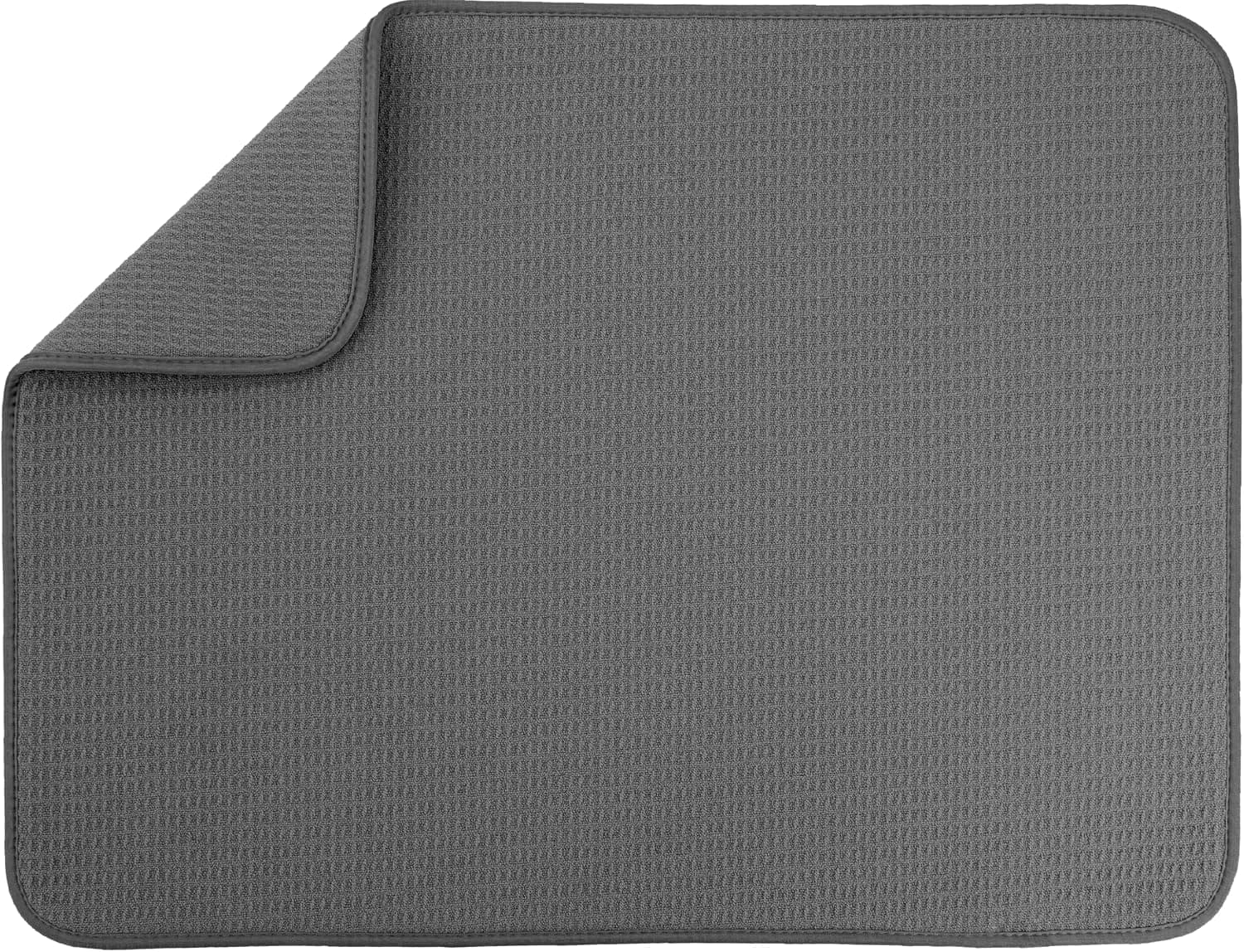
    S&T INC. Microfiber Drying Mat, 18 x 24 in

    S&T INC.

    S&T INC. Microfiber Drying Mat, 18 x 24 in

    At 18 by 24 inches this is the largest single mat here, which is the specification that matters most: a mat big enough to take a whole session of glassware in one layer is the difference between things drying and things sitting wet on top of each other.

    Best for
    The drying end of a station, where volume of water is the problem
    Key spec
    XL 18 × 24 in absorbent microfiber, machine washable
    • Large enough to hold a full session of glassware in a single layer
    • Microfiber absorbs volume rather than moving it around
    • Machine washable, so it can actually be maintained
    • Soft surface muffles the noise of glass set down on a hard counter
    • Microfiber stays damp longer than a stone or silicone surface
    • Needs laundering on a schedule or it silently stops absorbing
    • Not heat resistant — this is a drying mat, not a trivet
    View on Amazon

Skip these

Things people buy for this station that do not earn their space.

  • A countertop dish rack with a drip tray. It fixes the shape of what you can dry, it takes permanent counter that this station cannot spare, and the tray under it is the thing in the kitchen most likely to be growing something.
  • A five-piece bottle brush set. Two sizes cover every vessel on any of these stations; the other three end up in a drawer, and one of them is always the one blocking it from closing.
  • A countertop UV sanitizer box. Dish soap and hot water handle everything on a drink station, and the box occupies more counter than the drying mat it will not replace.
  • A bulk pack of thin microfiber cloths. They stop absorbing after a few washes and shed onto glassware. Two good mats and one cloth outlast a pack of twenty.

What you’ll make here

Techniques this station relies on

Keeping it usable

  • Launder the mats weekly and swap in the spare. A mat that has stopped absorbing looks identical to one that has not, so run it on a schedule rather than on judgment.
  • Empty the wet bin daily whether or not it is full. It is a small bin precisely so that emptying it is trivial.
  • Run the bottle brushes through the dishwasher or wash them by hand with everything else — a brush is a cleaning tool that also needs cleaning.
  • Hang the cloth every time, and replace it when it stops drying overnight. Follow the general kitchen-cleaning guidance in the FDA Food Code linked below for anything that contacts a drink.

Sources